










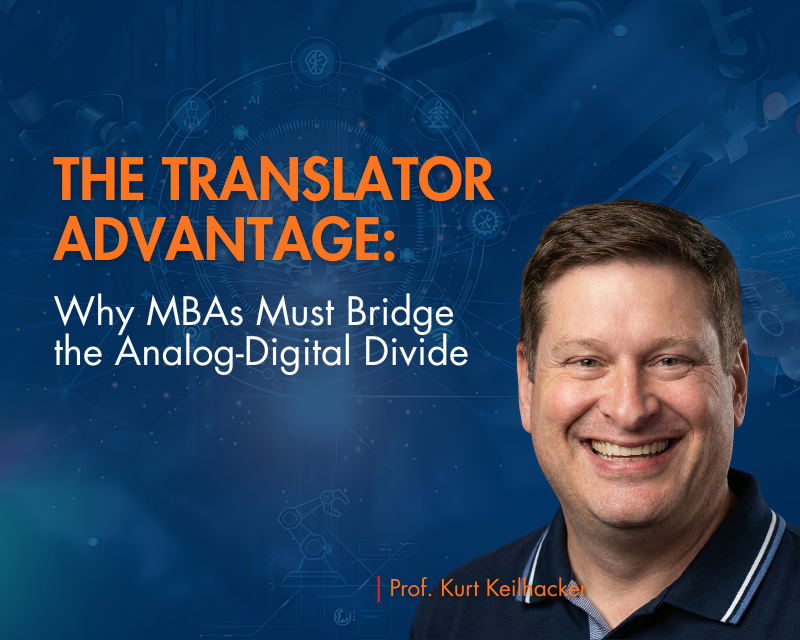
A conversation with Kurt Keilhacker on AI, career resilience, and the evolving value of business education.
When Kurt settles into a four-hour Saturday teaching session at HKUST, followed by back-to-back half-hour student consultations, he's not just fulfilling academic duties. For this Silicon Valley venture capitalist and educator, it's what he calls his "fun bucket", a deliberate choice that exemplifies his philosophy of lifelong learning and service. His choice bridges two worlds: the high-stakes arena of deep technology venture capital in Silicon Valley and the classroom where future business leaders are shaped. And according to Kurt, these aren't separate pursuits, they're part of a continuum.
The New Essential Skill: Becoming a Technology Translator
In an era where AI developments flood newsfeeds daily and traditional roles are being reimagined, Kurt has identified what he believes is the most critical skill for MBA graduates: becoming translators. "We need to be developing translators," he tells his students emphatically.
When you come out of here, the greatest opportunity you have is to go into organizations and help them make the transition from the analog to the digital AI-Powered world.
This isn't about becoming a programmer or data scientist. It's about something far more valuable: bridging the gap between technological possibility and organizational reality. "Most organizations will not be able to utilize the best parts of AI because of internal challenges," Kurt observes, "because of personnel that are afraid of it, thinking it's going to replace their jobs, or just haven't upskilled themselves." His prescription for students worried about career security? "If you develop that as a skill, you will have a job for at least the next decade. Become that technology translator in whatever field you want to go into—they're going to need you." Whether you're in real estate, healthcare, banking, or shipbuilding, the principle holds. Every industry needs someone who can show them how to move from what Kurt calls "simple electricity to superconductivity”-----his analogy for the leap from current capabilities to AI-powered possibilities.
The Marketing Blind Spot
One of Kurt's consistent observations, particularly in Asian business education, surprises many: the systematic undervaluation of marketing and brand building. "Marketing is as much strategic as finance, as management, as these other things," he insists. Yet he notices students gravitating toward his AI courses while treating marketing as "something that's a little bit general but not as important."
A recent investor letter from one of his portfolio companies—a hot San Francisco startup—illustrates his point perfectly. The CEO's update highlighted new hires: a Head of Design and Creative Direction from a Andreessen Horowitz-backed venture, alongside PhDs in neuroscience and computer scientists. The focus wasn't purely technical—it was about market understanding, brand creation, and customer connection.
The Great Reset Button
Despite ongoing debates about the MBA's relevance in the era of online education and rapid technological advancement, Kurt remains firmly committed to the value of the degree.
I have never met anyone, 20 years later, who says, 'Darn it, I wish I hadn't done an MBA,'" he notes. "That person is very rare."
Kurt emphasizes that the true value of an MBA especially for students with six to eight years of work experience, like those at HKUST extends far beyond the curriculum. It encompasses invaluable networks, rich experiences, and the opportunity to pivot and recalibrate career trajectories.
Learning by Doing: The AI Imperative
When Kurt tells his students that any of them could catch up on AI knowledge even if they "haven't worked yet with any AI models," he's not diminishing the technology's importance. He's emphasizing accessibility. "This is the year they need to really start getting caught up," he says. "But the way they get caught up is not by taking a course or program, but by playing with this technology on a day-to-day basis, trying things, failing at things, improving at things." His projects deliberately push students to experiment with Claude Code, Gemini, DeepSeek, and other tools. The goal isn't mastery of any single platform but developing fluency with the landscape. "Some of them are good for one thing, some are better for others," he notes. "And in six months, it'll be totally different."
The Continuum of Innovation
Perhaps the most revealing insight into Kurt's philosophy comes from how he describes his dual roles. Far from being separate careers, teaching and venture capital form what he calls a continuum. "When I'm working with a CEO in Silicon Valley, I'm working on the next generation of innovators," he explains. "But they're further along. They could only get there by having that experience before their MBA program. So it's those earlier innovators that I want to catch in MBA programs."
This perspective shapes his teaching. The frequent one-on-one sessions aren't just office hours—they're micro-consultations where he helps students navigate everything from course selection to career pivots, ensuring they understand how to position themselves for industries that are rapidly evolving. It's this combination of industry insight and genuine investment in student success that defines his approach.
The Future of Capital
Looking ahead, Kurt sees transformative changes on the horizon for how capital itself is structured and traded, changes he believes quite possibly could center in Hong Kong and Shanghai. "Right now you have public assets and private assets," he explains. “Private assets include private equity and venture capital. I believe that in the next five years, we're going to see blockchain technology impact those private assets." He envisions new capital layers on the blockchain that will allow investors different "slices" of capital beyond the current structure of common and preferred stock each with various rights and preferences. "These two cities—Hong Kong and Shanghai—will be leading places of innovation for those new types of things," he predicts with conviction.
A Day in the Life
Kurt's energy is palpable when he describes his routine in Hong Kong: "I can barely wait until the next morning to wake up and start. I'm so excited about the next day." His learning discipline is straightforward: the first hour of each day is devoted to surveying developments, particularly in AI. During the January-to-February period, when announcements flood the tech world, he practices what he preaches to his marketing students about filtering noise. "If there are 100 announcements, maybe only 10 really matter. Maybe five you heard of before. Maybe five are new. You focus on three of the five, and you do the other two, two or three months later." It's the same skill he wants his students to develop: picking up motion, focusing on what matters, and filtering out peripheral distractions.
The Meaning Question
What keeps Kurt engaged across both venture capital and academia? "I wanted to build out a lifelong opportunity of learning more and of also helping to serve other people," he says. "I'm a better venture capitalist because I've done these other things, and I'm a better teacher because I've done these other things." While many of his peers from early Silicon Valley success retired to golf courses and private jets, Kurt chose differently. He chose the continuum of investing in next-generation innovators, whether they're in his classroom, in his portfolio companies, or somewhere on the journey between.
For students questioning the relevance of an MBA in the age of AI, Kurt's own path offers a compelling answer: the degree isn't about learning static skills, but about positioning yourself at the intersection of technology, strategy, and human insight, exactly where the most valuable opportunities will emerge. "This is my fun bucket," he says with a smile, referring to his teaching commitment. And for anyone who's witnessed his 12-hour Saturday—teaching, consulting, energizing, it's clear he means it.
* Kurt teaches venture finance, marketing analytics, and strategic AI courses at HKUST Business School while maintaining an active venture capital practice focused on deep technology investments in Silicon Valley. His students range from the full-time HKUST MBA program to part-time MBA students across Asia and beyond. *