










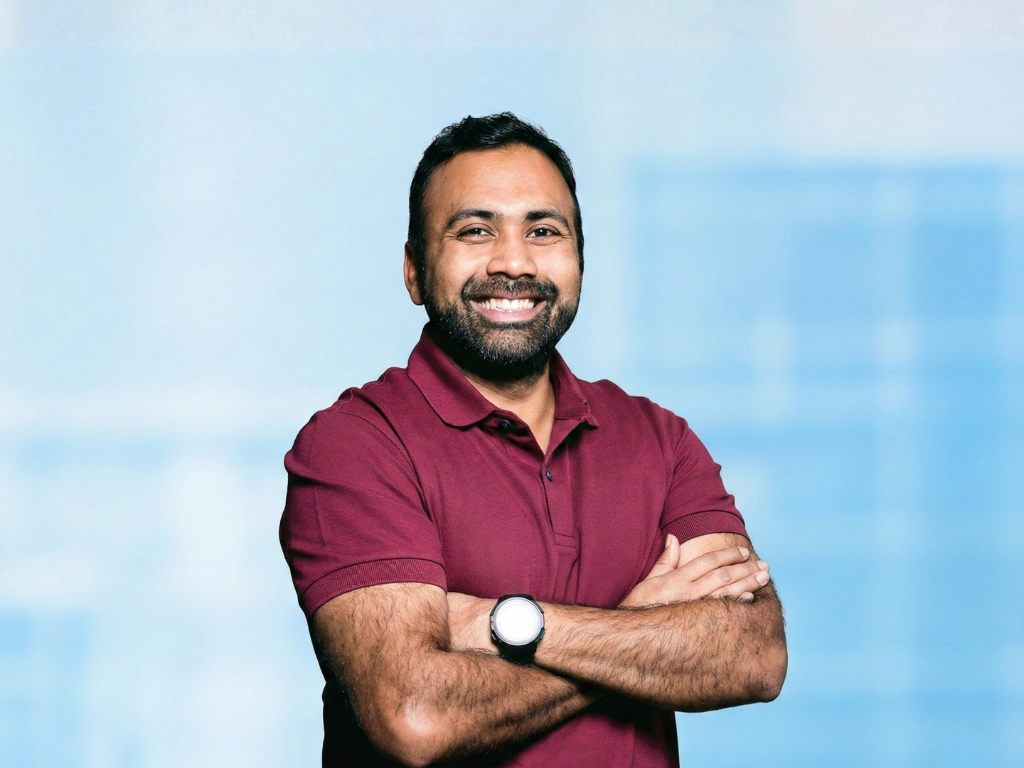
Sudhanshu Mohanty joins this interview midway through another intense afternoon at Airwallex. "It's been the craziest start to the new year I have ever experienced in this company," he says with a laugh, pinning it on U.S.-China data tensions that have upended processes overnight. At the helm of the Revenue Operations team - what he calls "the brain and engine behind the commercial team", Sud sits where data, product, and frontline sales collide, orchestrating systems that turn thousands of leads into long-term customers.
Born in India, Sud arrived in Hong Kong at age five in 1992, when his father chased shipping opportunities in the city's heyday as a global hub. International schools shaped his childhood here, but university and early career pulled him to the U.S. and U.K. for chemical engineering. By his mid-20s he had helicoptered into North Sea oil platforms, endured underwater escape drills, and spent months with just one weekend at home yet he had never professionally worked in the city he still called home (Hong Kong). "I think at one point, I maybe spent one weekend at home, and the rest of the time I was always abroad, going to sites," he recalls. Volatility hit hard in Houston as oil prices tanked, prompting a question: why tether his future to such swings?
The pull of home
Craving stability and proximity to family, Sud eyed an MBA to re-enter Asia. He applied only to Hong Kong and Singapore programs, landing offers from HKUST and NUS. A close friend from the 2015 HKUST cohort tipped the scales, "plus, I know this sounds bad, but I really don't like the weather in Singapore," he jokes. The irony was not lost on him: he returned to Hong Kong in June 2017, only for his parents to pack up and leave for Germany two months later when his father was asked to open the Hamburg office. "I came back, and then they were like, oh, okay, actually we're gonna go. I was like, dah, okay." The reunion finally came when his father retired in 2024 and the family returned to Hong Kong permanently.
Rewiring an engineer's brain
HKUST's full-time MBA hit at the right moment. Statistics courses taught him to wrangle messy datasets; macroeconomics revealed "how money moves, why companies borrow, why companies make shares." More critically, professors drilled a new habit: don't just present numbers, translate them into business impact tailored to your audience. "You throw numbers at a head of sales, they'll understand it, but that's not their priority. You need to translate it in a way that makes business sense to them," Sud explains. Root-cause analysis, asking "why" repeatedly until no deeper reason remains, became a mental reflex he still deploys daily.
That's my mindset now. If someone tells me revenue has been slow, my job is not only to understand why, but also prove why, and then come up with a solution.
Leadership in the chaos of case competitions
Sud's leadership style crystallized in group projects and a Wharton leveraged-buyout case competition where his team drawn from finance, consulting, real estate, and management backgrounds, tackled an acquisition question about Under Armour. "It wasn't about getting a lot of finance people together," he recalls. "It was about getting people of different skills and working with the strengths of each team member." While many competitors argued against the buyout, Sud's group said yes. Under Armour has since thrived, validating their contrarian call. Asked to describe his leadership in a few words, he offers:
An empathetic leader that understands and harnesses the strengths of their teammates and colleagues to achieve the final goal.
Building the revenue engine at Airwallex
Sud’s transition from engineering to operations began with an opportunity through HKUST Career Services. The Career Professional Development (CPD) team had built strong ties with Infiniti Motor Company and featured them at a career fair, where Sud’s application led to an internship placement. Among several interns, only two including Sud converted their roles into full-time positions in sales operations.
After launching his operations career at Infiniti, Sud joined Airwallex, a decade-old fintech that still operates with a startup mindset. Tasked with mapping the entire inbound sales journey for the company’s highest-revenue team, he was asked to “scrap and rebuild” what wasn’t working. Through redesigned stages, streamlined tools, and more frequent customer touchpoints, expanding early contacts from one or two to about four, his team lifted lead conversions from around 50% to 75–80%, driving double-digit revenue growth. “You’d think it would take complex algorithms,” Sud notes. “But it’s actually simple: analyze the process, find the leaks, and plug them.”
AI and the art of letting go
More recently, Sud has built AI agents that handle basic queries, qualify leads, and pass only warm prospects to human reps, cutting each salesperson's grunt work by an estimated 10-15 hours per week. The culture at Airwallex prizes "Move Fast with Conviction," a principle that encourages launching minimum viable ideas quickly and iterating rather than waiting for perfection. "They'd rather you execute and fail, instead of spending months trying to come up with something perfect," he says. Thriving in such an environment means accepting that months of work can vanish overnight. "If you are the type of person who's very emotional about holding on to things you've built and not able to let it go, then it will be tough for you."
Who thrives in high-growth startups like Airwallex?
When asked what type of person suits a fast-scaling fintech, Sud rejects rigid profiles. "The mindset needs to be very fast-paced," he emphasizes. Thriving means accepting sudden pivots, "projects you've built for months can get scrapped overnight" due to policy shifts or strategy changes and not getting emotional about it is key to fitting in. Success favors those who understand cross-functional needs, stay vocal about their strengths, and chase opportunities beyond their lane. "Airwallex promotes talking to as many people as you can... there's a hierarchy, but a very horizontal feedback loop," he notes, contrasting it with banks where you "become a number."
Busting myths: Language and Hong Kong jobs
International students often ask about language barriers in Hong Kong. While roles increasingly demand Cantonese or Mandarin amid mainland integration, "especially now," he acknowledges, scarce skills still open doors. Technical or commercial expertise in multinationals can trump fluency if paired with local market savvy. After a stint in Shanghai, Sud admits his own Chinese is limited, yet his career flourished.
You do need to speak it for more opportunities, but if you have something unique to offer, that's still highly sought-after.
Networking like an introvert
Despite describing himself as an introvert, Sud has become a thoughtful advocate of networking, especially in Hong Kong's relationship-driven job market. His advice: stop leading with "I'm looking for a job." "I don't like to sell myself. I like to learn more about what the person I ‘m talking to is doing, how they've excelled in their career. Honestly, people like talking about themselves." The goal is to plant a seed so that, months later, they have an "aha" moment and think of you when a role opens. "The most important thing with networking is that they remember you."
Full circle
Today, Sud embodies the spirit of mentorship, eager to guide incoming students and plans to bring his wife and seven-month-old son to see the campus he still calls "one of the most beautiful." Looking back, he wishes he had taken more leadership roles in student clubs, honed his storytelling for different audiences, and chased events like FinTech Week earlier. He still carves out 15–20 minutes a day for Python learning, inspired by the book Atomic Habits: "It's not about learning for 10 hours straight. It's about consistency over a long period of time."
If he had to give one piece of advice to incoming students, it would be this:
Learn as much as you can in the courses, but focus your energy on building relationships through networking with people, not just to get a job, but a genuine relationship. If your mindset is 'I want to learn as much as I can,' that changes things. Everybody likes somebody who wants to learn, and who's coachable, and wants to evolve.