










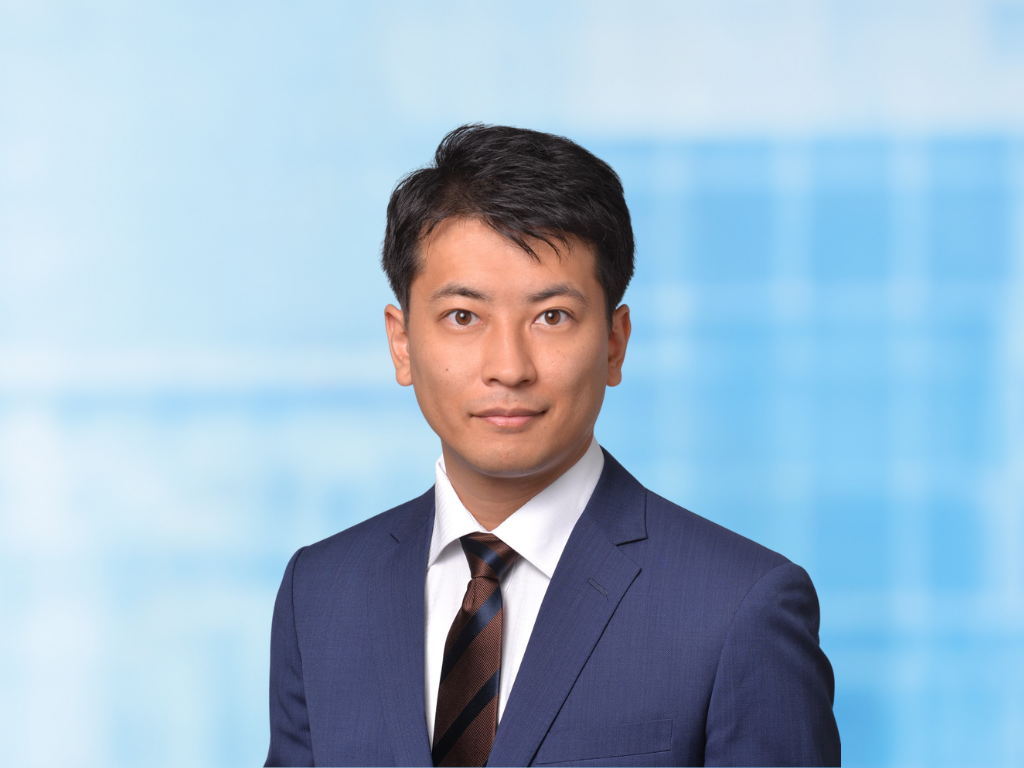
Featured Alumnus: Yukinori Kakishita (HKUST Full-Time MBA, Class of 2018)
Every job has two layers. One is following a process someone already designed. The other is designing the process itself. For most of history, the first layer is what got you hired. Lately, it's the layer disappearing fastest.
Yukinori (Yuki) Kakishita noticed this shift years before it had a name. He started his career in IT consulting in Japan—work that ran entirely on blueprints. A client had a problem, there was already a proven method to solve it, and Yuki's job was to execute that method well. Do it accurately, do it on time, and you were good at your job. Nobody was asking whether the blueprint itself was the right one.
When Yuki chose to apply for an MBA, the decision followed a kind of blueprint too, at first. He wanted a program centered on Asia—not a European campus with an Asia elective bolted on. He toured several programs in person, yet one left an impression for reasons he hadn't anticipated.
It was mostly lectures: sit, listen, take notes. I wanted a room where people disagreed with me in real time, not one where I just scribbled notes. HKUST was that room.
The real breakthrough happened in a case competition rather than a classroom.
In consulting, I was handed the process. In the case competition, nobody was going to hand me anything. I had to decide what 'good' looked like before I could even start.
Nobody hands you the blueprint. You write it.
It sounds like a small distinction, but it wasn't. Yuki traces his eventual move into strategy consulting directly back to that shift—from executing a method to building one. He had found the part of the job that was truly his.
The classroom did its own version of the same work, just more quietly. Yuki points to professors like Larry Franklin, whose economics courses were built around real companies and high-stakes decisions rather than abstract models.
They didn't teach economics like pure theory. Every case was something that had actually happened to a real company. That’s when it stopped feeling like a course and started feeling like real-world training.
It delivered the exact lesson the case competitions taught him: business isn't a set of neat equations; it's a series of judgment calls someone actually has to make.
That distinction matters more now than he could have guessed. Consulting has absorbed AI faster than almost any other industry, and the roles disappearing fastest are the ones that most resemble the blueprint work Yuki started in—structured, repeatable, and well-defined. What hasn't gone anywhere is the earlier, harder step.
AI can test a hypothesis for you, but it can't tell you which hypothesis is worth testing. That part is still on the consultant.
An MBA that once mattered primarily for foundational blueprint skills—accounting, finance, structured frameworks—matters just as much today, but for a different reason. It may be one of the few environments built to train the part of the job that can't be automated: deciding what to build in the first place.
By the time he graduated, the MBA hadn't just sharpened how Yuki approached problems; it had changed how he showed up in a room. The clearest evidence of that was communication. He had expected the program to polish his English, which it did. What he didn't expect was learning that language fluency and workplace fluency are two different things.
Some of my colleagues could run a formal meeting in English just fine. What they couldn't always do was just talk with someone from another country about nothing in particular. That’s actually where real trust gets built.
The MBA gave him that context—enough of a shared perspective that a conversation with a colleague from India, or anywhere else, didn't have to start from zero.
He has put all of it to work. His career has spanned Japan, Hong Kong, and now Bangkok, where he helps Japanese companies establish their footing across Southeast Asia. While it is a specific cross-border niche, it is also part of a macro movement. More Japanese professionals are choosing to build their careers outside Japan than in years past.
The opportunities outside Japan have gotten better relative to what's available at home. That's not restlessness—that's just people doing the math.
He's one data point in that shift, having navigated it from the inside rather than reading about it after the fact.